Category: Learn More

Posts about information useful to the ULUG community, such as train loop standards or information about drafting.

  • MOCs

    MOCs

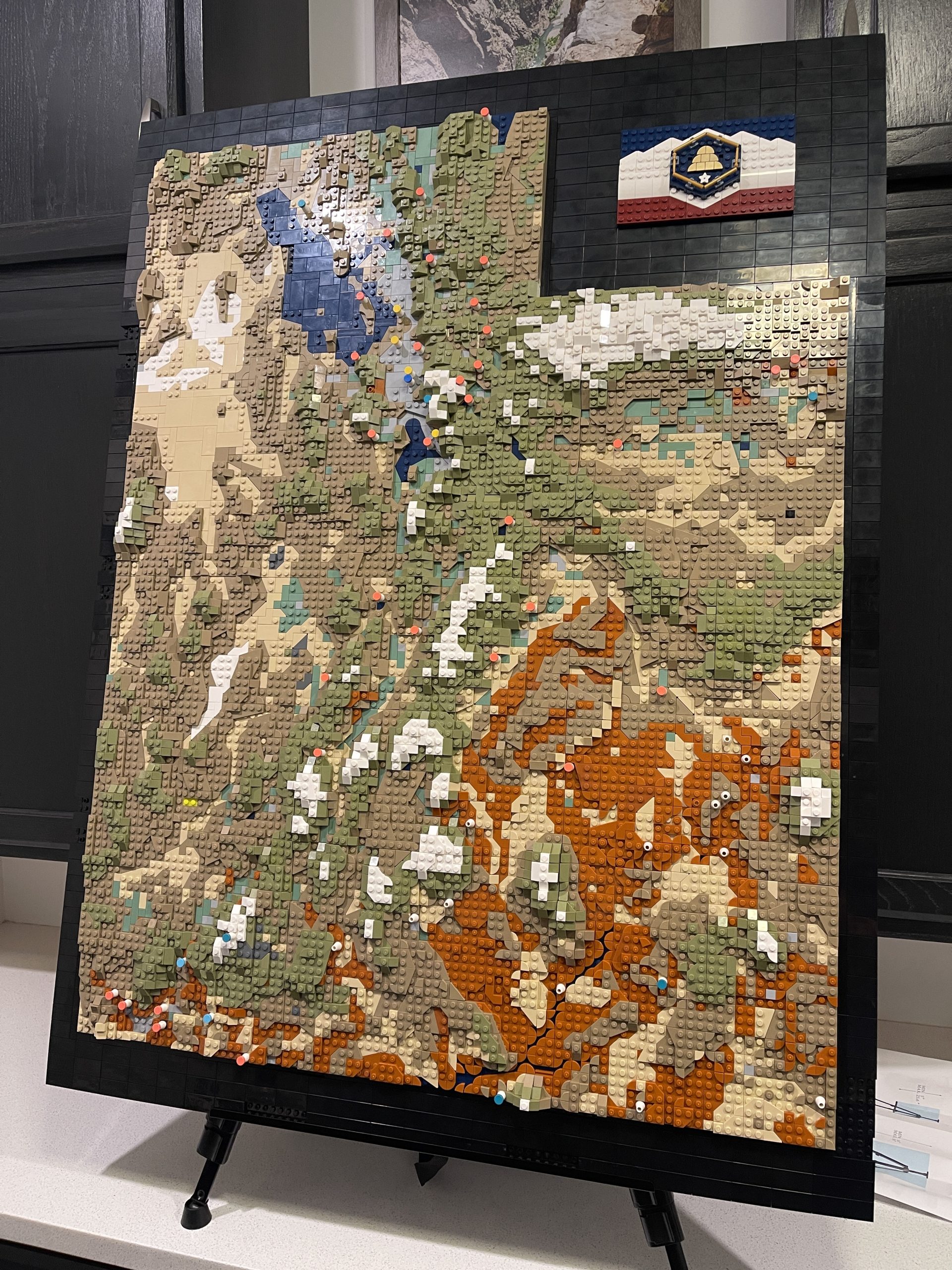
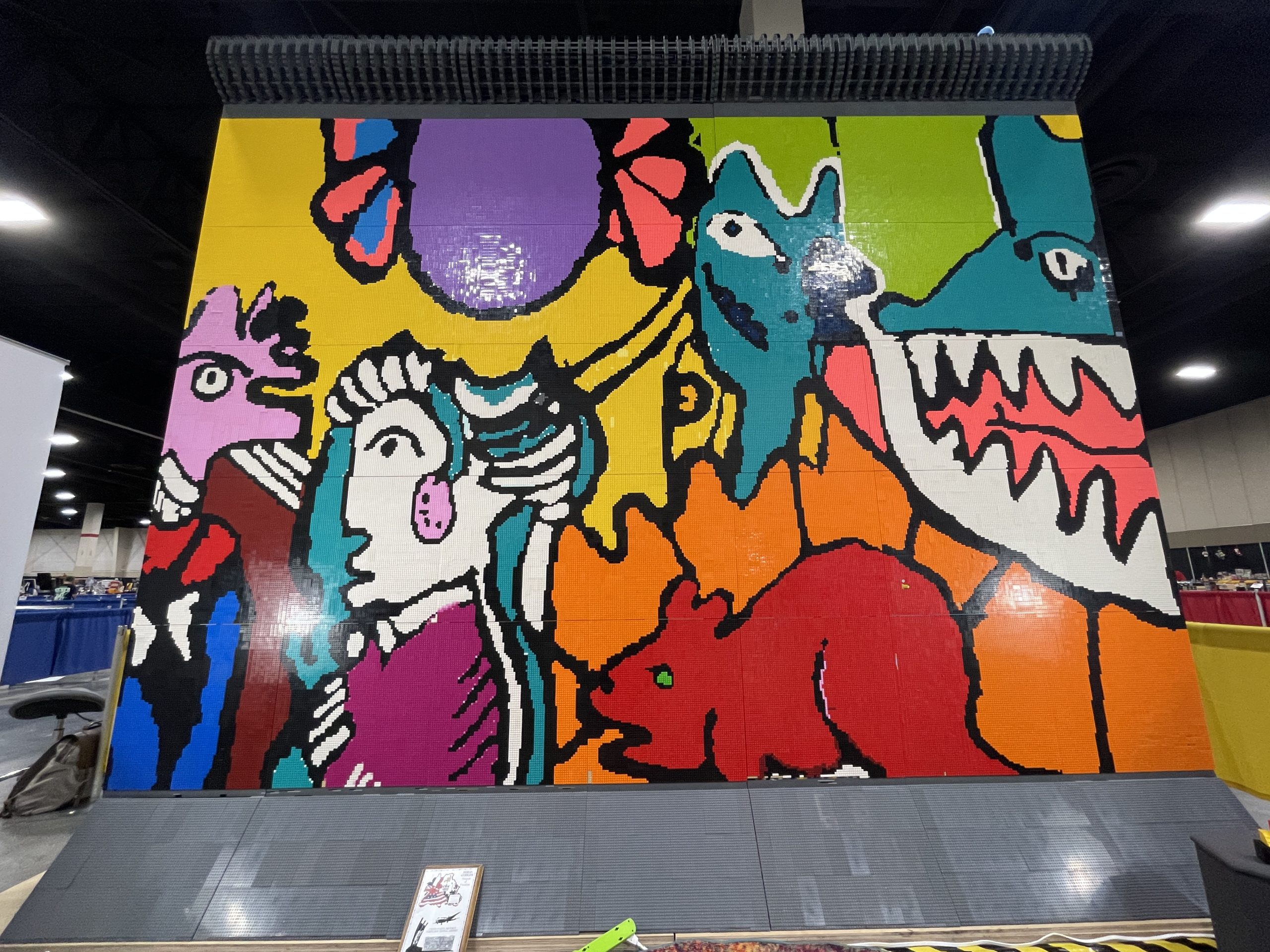
    A MOC stands for My Own Creation. A MOC is any custom build made without following official LEGO instructions. A MOC can be anything, in any size – a spaceship, a car, a castle, a sculpture, a building, or anything else you can imagine and bring to life with bricks.

    Building custom creations out of LEGO bricks is a fun and artistic expression of creativity and engineering. All it takes is a few bricks, some patience, and some creativity to create something new.

    Share Your MOC

    Each meeting has time set aside for ULUG members and guests to share MOCs with the group. Just bring your MOC up to the table when you arrive! Meetings are a great time to show off cool builds, ask for feedback from other members, and inspire fellow builders.

    Each MOC gets time for the creator to introduce themselves, share their build, and highlight one or two things about it.

  • Drafting

    Drafting

    What is a parts draft?

    Named after sports drafts, a parts draft lets participants take turns choosing LEGO parts they want in higher quantities.

    Drafts are a cost-effective way to get LEGO parts in bulk, and a fun way to interact socially with other builders.

    Multiple copies of a LEGO set are opened and sorted into groups of identical parts (same shape and color). Each group is called a lot. When it’s your turn, you choose one lot and keep all of the pieces. Drafting continues until all of the lots are gone — and everyone leaves with a big pile of parts.

    How do I participate?

    Participation is simple! All you need to do is:

    1. Come to a ULUG meeting.
    2. Pay the $20 participation fee (see details below).
    3. Have fun and leave with lots of new parts!

    Tips for First-Timers

    • Look over the parts list ahead of time. Some builders draft for their next project, some look for high-value parts, and others just want unique colors or elements. Having a few parts in mind helps you feel less rushed during your picks.
    • Bring a bag. You’ll end up with a lot of loose pieces. A gallon-sized zipper bag, several small bags, a hobby organizer, or a box all work well.
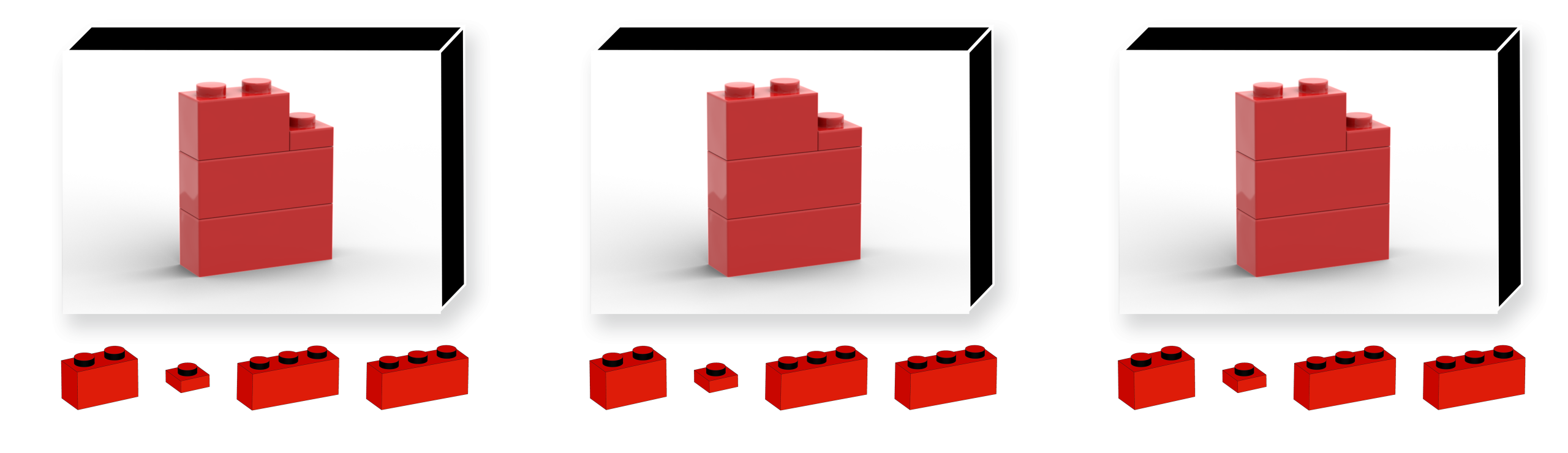
    • Don’t overthink your picks. Try to get the parts you care most about early on, and don’t overthink the rest. All of the parts you get can be useful. If you’re unsure what to grab, here are some parts we never seem to have enough of:
    • Have fun! Be a good sport and don’t take the draft too seriously. Everyone is there to get cool parts and build cool things. You’ll walk away with great parts, even if you don’t get all of your top picks.

    ULUG Draft Details

    Sets and Participants

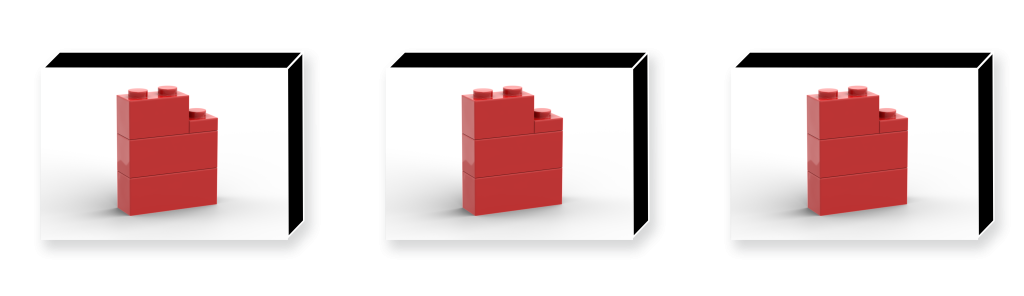
    Multiple copies of the same set to draft. Simplified example.

    ULUG provides multiple copies of the same set for each draft, so participants do not need to bring a set. Each draft set is announced ahead of time on Discord. The number of sets opened depends on how many people participate.

    Payment is made at the time of the draft; there is no sign-up or reserved spots. The participation fee is $20. Payments can be made via PayPal, Venmo, or cash.1 Members may purchase multiple draft spots.

    Part Out the Set

    Parts sorted into lots. Simplified example.

    Once the regular meeting is over and the drafting portion begins, participants open the sets and sort all unique pieces — every part in each color is separated into its own lot.

    There are a few exceptions:

    • Minifigures: Assembled together, including legs, torso, head, hair or headgear, and fabric elements such as skirts or capes. Accessories like weapons or tools are separate lots.
    • Paired or functional elements: Pieces designed to work together, such as two halves of hinges or turntable bases and tops, are kept in a single lot to ensure they function properly in builds.
    • High quantity lots: Occasionally, after combining multiple copies of a set, a lot may have a very high quantity of pieces. These lots can be split into smaller lots so more participants have a chance to pick them. Decisions about splitting are made by the ULUG officer overseeing the draft before the first pick is made.
    • Some sets have very large quantities of highly-desirable or rare parts. Those can be split into multiple lots to allow more people a chance to walk away with them. These decisions are made by the ULUG officer overseeing the draft (normally with input from the group) as the parts are being sorted.

    Sorting is a fun and social group activity, and getting to know your fellow sorters is encouraged.

    Draft Order

    Once the participant list is finalized, a club officer or their appointee determines the draft order randomly. Since going early in the first round provides an advantage, randomizing the order ensures fairness for all participants.

    Drafting the parts

    Once the lots are set up on the table and the draft order is determined, the draft begins. On their turn, each participant chooses a lot and keeps all of the pieces.

    A few picks work differently:

    • Minifigures: Each individual minifigure counts as its own pick.
    • Instructions and stickers: Each set of instructions or stickers counts as its own pick.

    To keep the draft fair, the pick order reverses after each round. This means the last drafter in one round goes first in the next. This pattern continues until all lots are picked. This reversing order is often called a snake draft, named for the way a snake’s head weaves back and forth as it moves.

    Once the last lot is picked, the draft ends — and everyone walks away with a bulk of fun parts!

    1. If paying in cash, the exact amount is required. No coins or large bills are accepted. Electronic payment is preferred. ↩︎
  • Display at an Event

    Display at an Event

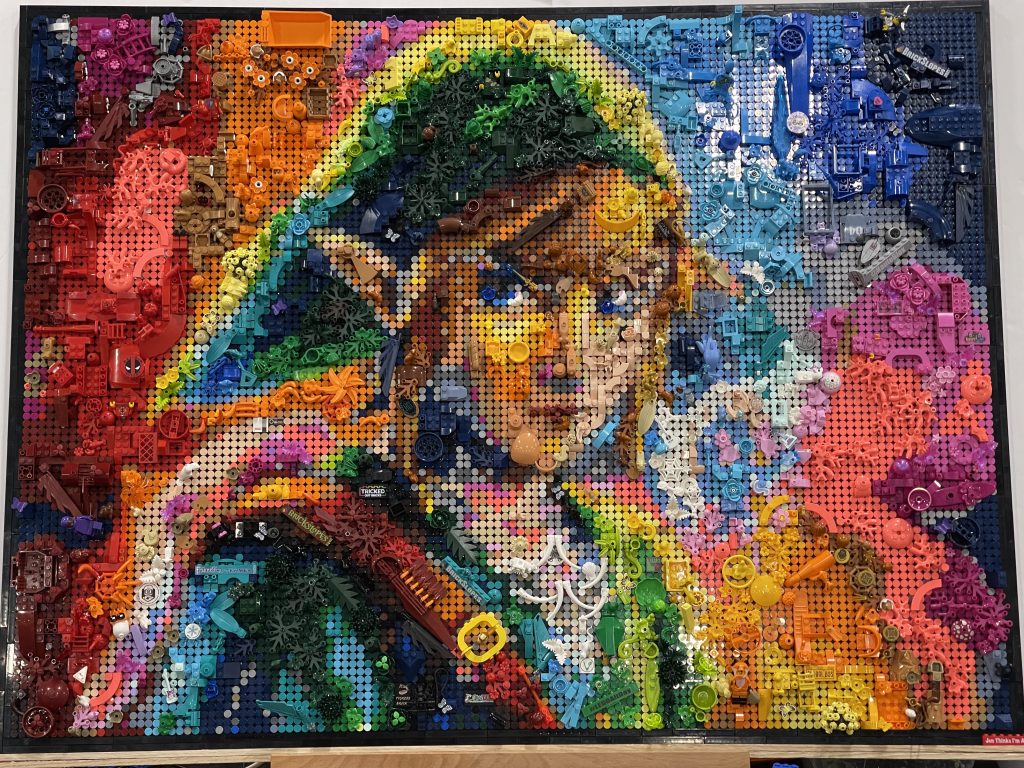
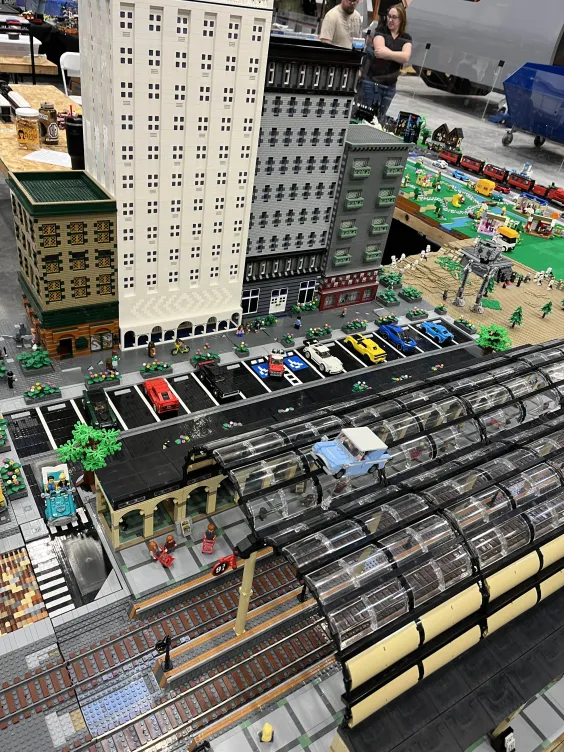
    MOC by ULUG member Roxanne.

    You must be a ULUG member to display at a ULUG event.

    Sign Up to Bring a Build

    Members can sign up to display by joining ULUG and participating in event planning. Each event has a dedicated Discord channel where:

    • Event details are shared.
    • Builders coordinate layout and space.
    • You can post how much you’d like to bring.

    Simply find the event channel and let the group know your plans. Further details and coordination will happen there.

    Display Sections

    ULUG displays are organized into standardized sections, often called MODs (a common term in train clubs). The full club layout is built from these sections so tables can be planned accurately.

    A standard display section is:

    • 3 baseplates wide.
    • 6 baseplates deep.
    • Approximately 2.5 feet wide × 5 feet deep.

    Train loop sections are the same size, but have additional standards.

    A Train Loop Section (MOD)

    Many events also include a separate area for smaller MOCs, which are welcome and encouraged. Some events only have space for a train loop.

    Space signup is done by requesting a certain number of sections, and specifying whether that build is part of the train loop.

    At the Event

    Set Up

    The event coordinator will share setup times and logistics via Discord. We typically set up tables and builds before the public arrives.

    One important rule when working around LEGO: never touch someone else’s build. If something needs to move or is in the way, always find the builder or the event coordinator.

    During the Event

    Builds are separated from the public with clear plexiglass attached to the display tables. This helps ensure the public doesn’t accidentally break anything—or (perhaps purposefully) walk away with minifigures or parts.

    If you’re able to stay during public hours (even for a portion), you’re strongly encouraged to do so! Interacting with the public is rewarding for both builders and viewers.

    Take Down

    The event coordinator will share takedown times and logistics via Discord. Takedown usually goes much quicker than setup. Packing and loading club tables is a lot of work, so any help is greatly appreciated.

    Be sure to report your participation using the participation survey. This helps with membership status and allows us to include photos of your build in the event report on the website and for LEGO.

    Displaying at BrickSlopes

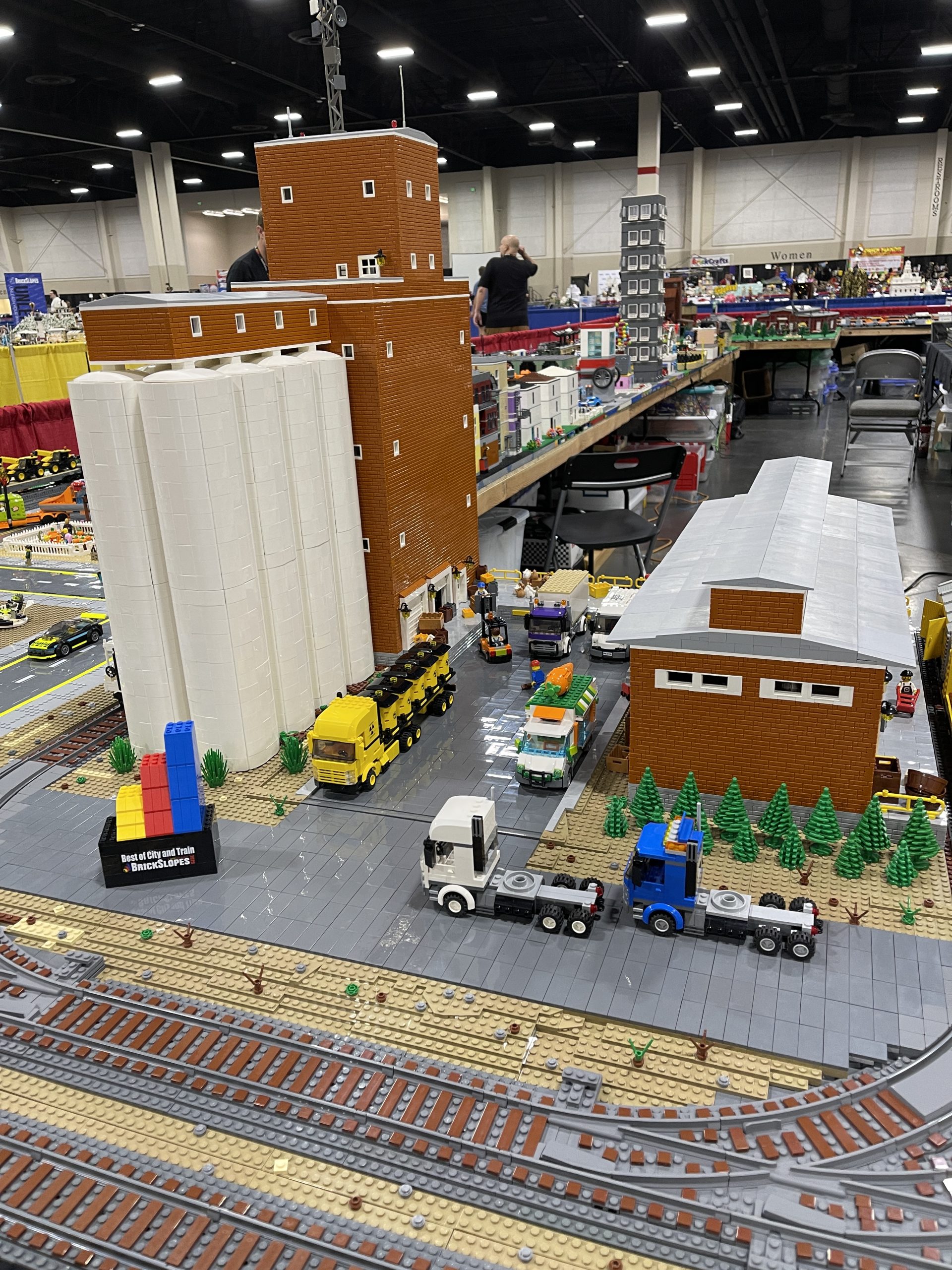
    BrickSlopes is the largest LEGO convention and show in the Mountain West. It is not a ULUG-organized event, and ULUG membership is not related to BrickSlopes participation in any way. However, many ULUG members present their biggest and best MOCs at the show, and it’s a great opportunity to meet builders from around the country.

    To display at BrickSlopes, you will need a pass directly from the convention and coordinate builds through their website and/or communication platforms.

    While not a ULUG event, ULUG typically partners with BrickSlopes to organize and sponsor the train loop at the event. The loop is open to all BrickSlopes displayers, regardless of ULUG membership.

  • Train Loop Standards

    Train Loop Standards

    A major feature at many of our events is the train loop, where multiple builders connect their sections side by side and run trains across many different builds. For the loop to work smoothly, all builders must follow a set of standards for track placement, heights, and track alignment.

    Layout Overview

    Each section of the loop (called a MOD, as is common with train clubs), has a basic layout of 3×6 standard LEGO baseplates (32×32 studs each). This makes a total measurement of 2.5 feet wide, and 5 feet deep.

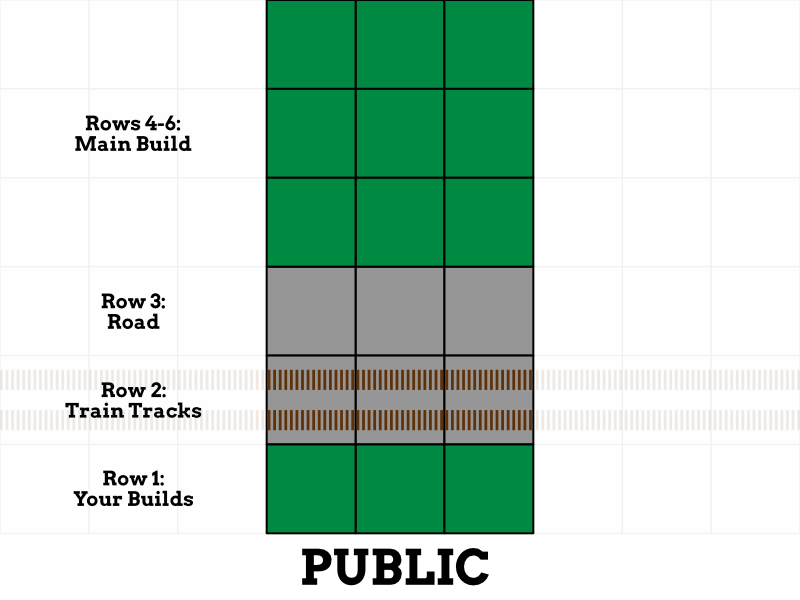
    To maintain a consistent, workable loop, each section follows a general layout from front (public) to back:

    1. Front row with custom builds
    2. Train track row (2 lines)
    3. Road row
    4. Main build row
    5. Main build row
    6. Main build row
    A diagram of a display section or MOD in a 3 column, 6 row grid. The bottom has a Public label. The first row is labeled Your builds. The second row is labeled train tracks. The third row is labeled road. Rows 4 through 6 are labeled Main Build.

    Edges of each section that connect to neighbors must match these standards to ensure a cohesive display.

    Layout Details

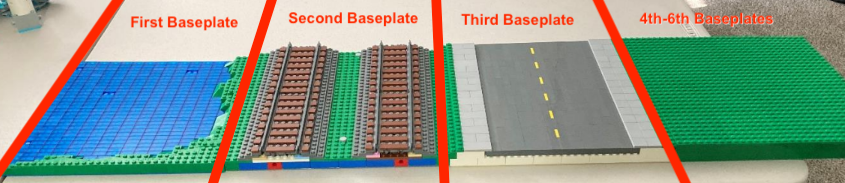
    An example of a cross section of the first four rows of a section: first baseplate, second baseplate with train tracks, third baseplate with road, 4th baseplate for custom builds.

    Front (Row 1)

    Requirements

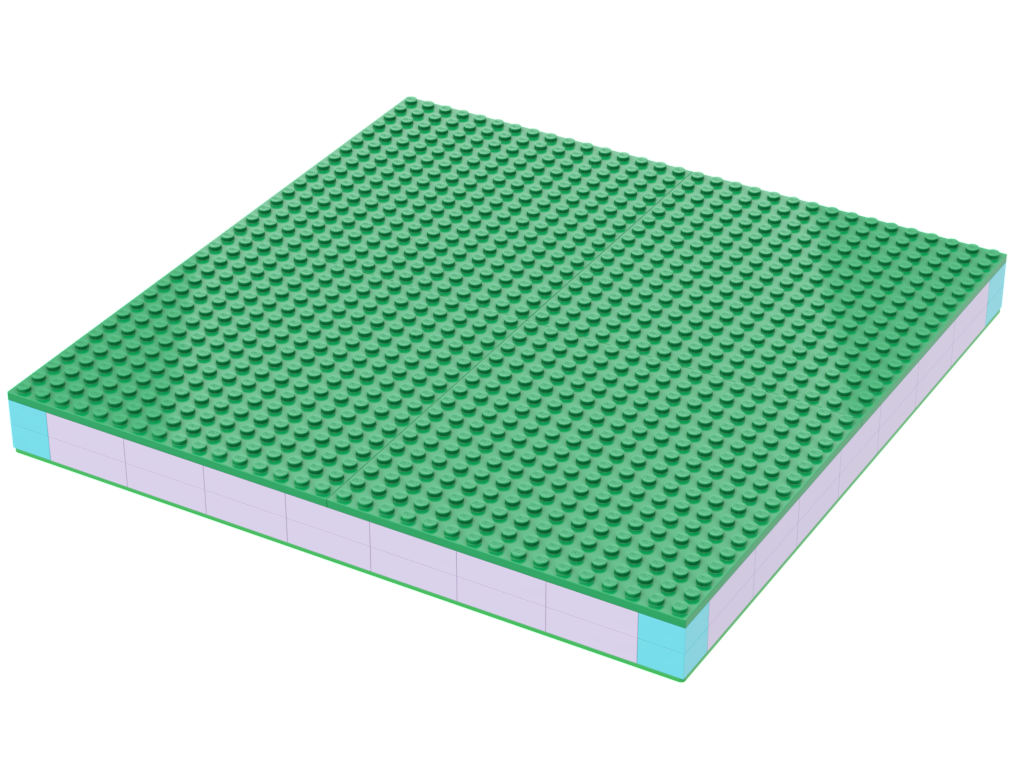
    The front row sits at the edge of the table against the plexiglass. The row is built to a height of 1 baseplate, 1 brick, and 1 plate at the edges, which is the standard MILS height.

    Side view of a standard front section. A layer of plate on top of a layer of brick on top of a baseplate.

    Consistency

    The height at the edges should match neighboring sections. The brick beneath the landscape on the front edge should match the color of the landscaping, while bricks at the back or sides are hidden and may be any color.

    Notes

    Front baseplates can feature any custom build, or be kept sparse. They are typically kept at a smaller height to ensure trains and rear sections remain visible.

    Make Your Own Front ROw

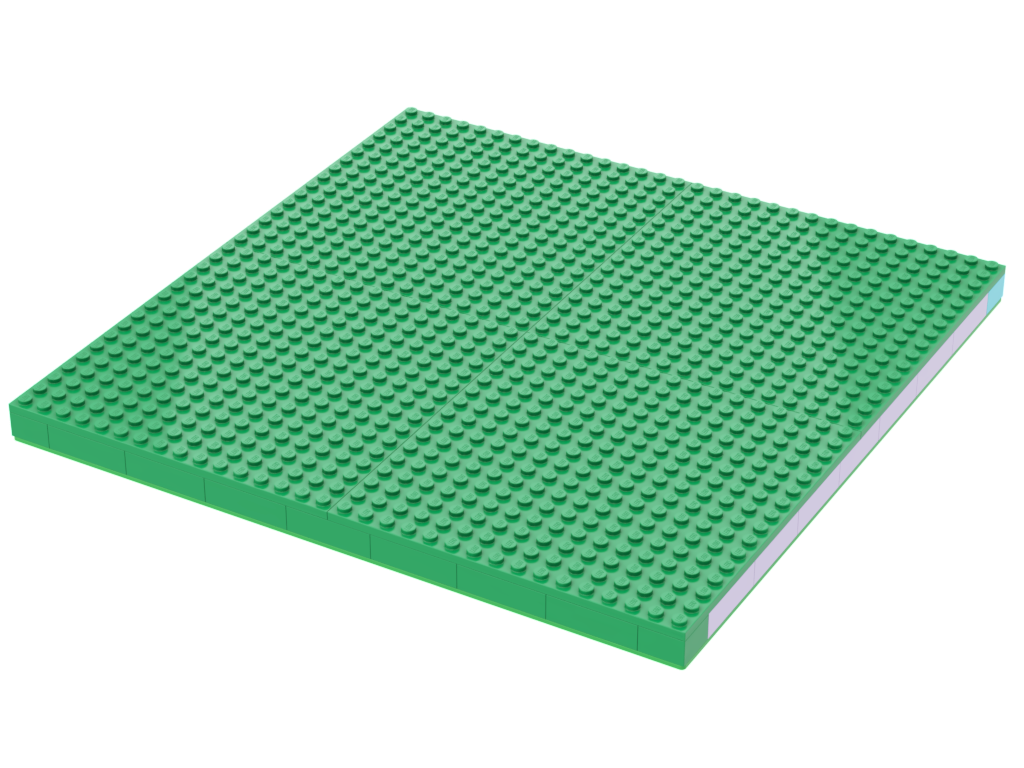
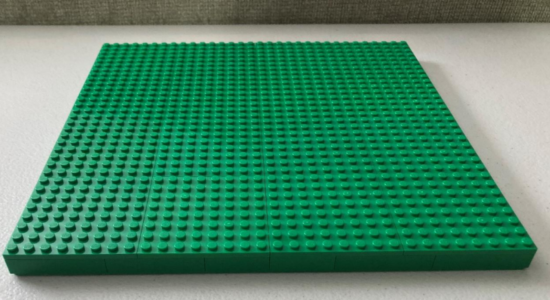
    An example 32x32 stud front row section of all green, looking like an empty field of grass.

    Train Tracks (row 2)

    Requirements

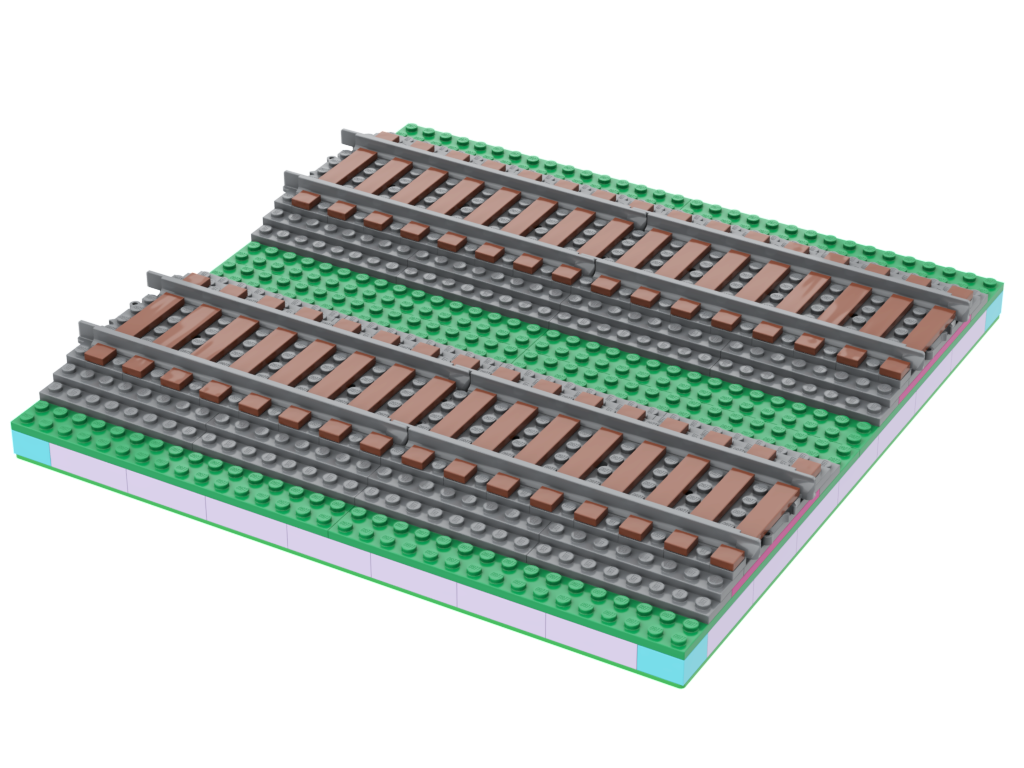
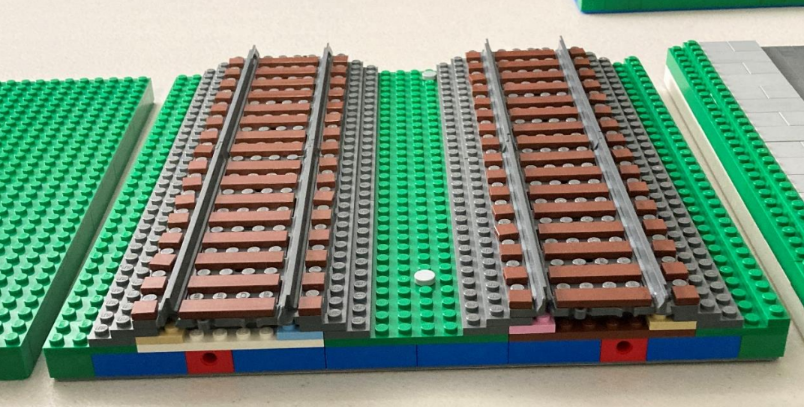
    The track row is built on a baseplate with a brick and plate for landscaping, maintaining the same height as the front row. Two plates of dark bluish-gray ballast sit on top of the landscaping, with the tracks above. When ballast is not used, the tracks rest directly on two bricks. The track starts 4 studs from each edge, with the ballast beginning 2 studs from the edge.

    Consistency

    Unlike other rows, the tracks must remain straight and level across the entire section. Landscaping can vary, but the track alignment must be consistent to allow trains to run smoothly.

    Notes

    Railroad ties start on the audience’s right side and go every other stud. Ties are typically reddish-brown.

    Builders often add a single plate along the edge next to the road to smooth the height difference between the tracks and the road.

    Make Your Own Train Tracks

    Road (Row 3)

    Requirements

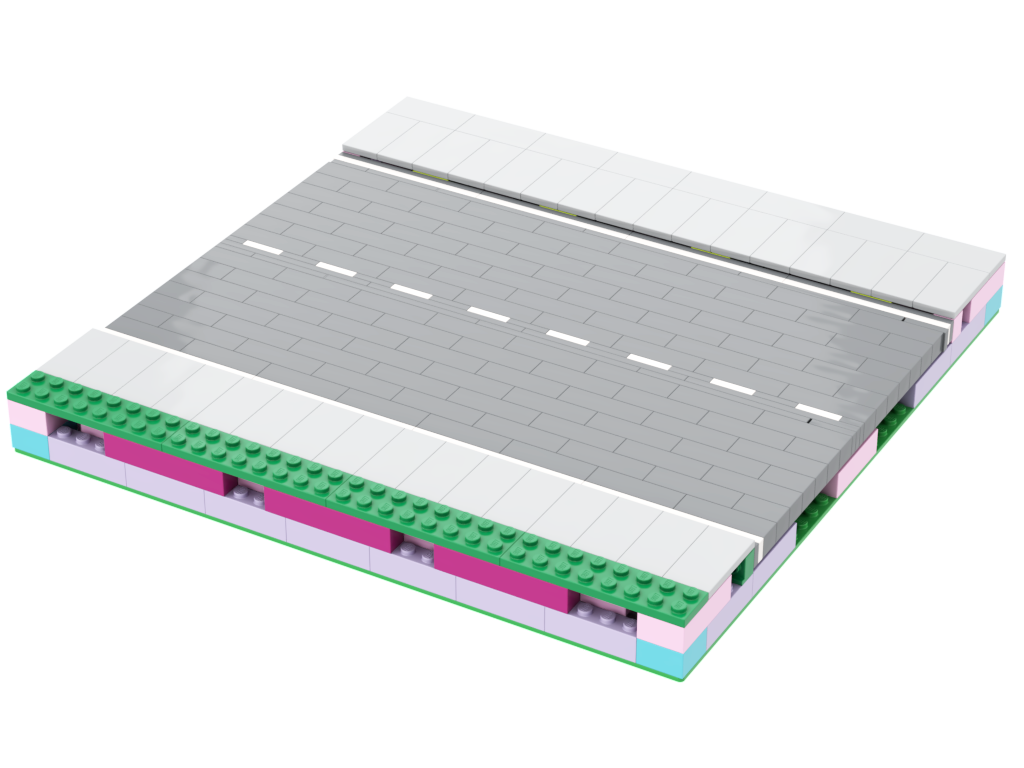
    The road row is built on a baseplate with two bricks and a plate for landscaping. The road itself sits one plate lower than the surrounding landscaping, creating a small curb. Typically, there are two studs of landscaping before a 4-stud sidewalk (usually light bluish gray), followed by a 20-stud-wide road, a second sidewalk, and the final two studs, which can either extend the sidewalk or transition to the main build in the next row.

    The preferred road color is dark bluish gray, but black is also common.

    SNOT Road
    Road with Road Plates

    Consistency

    Only the edges of each section need to match neighboring MODs for a cohesive loop. The height of the road at the edges and the position of the sidewalks must align with adjacent sections. Curves, intersections, and cross-streets are all things that have been done within a single section.

    Notes

    Two road types are commonly used:

    • SNOT Road: Built using bricks sideways (studs not on top or SNOT). The road rests on a single brick and allows flexibility for custom road striping.
    • LEGO City Road Plates: Road plates sit on a brick and a plate, with additional bricks or SNOT sections added on the sides to achieve the 20-stud width requirement.

    Be creative elements such as curb details, crosswalks, streetlights, small landscaping features, or more!

    Make Your Own SNOT Road

    Make Your Own with Road Plates

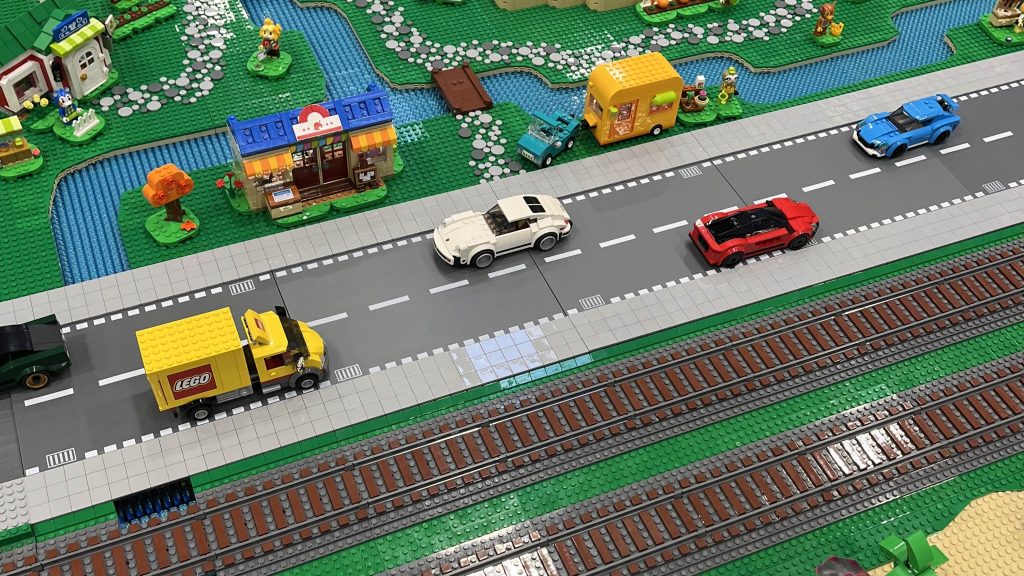
    Example road in a train loop section with landscaping and vehicles.

    Main Build (Rows 4-6)

    Requirements

    The main build rows sit on a baseplate on top of two bricks, flush with the sidewalk. This establishes the standard edge height for the section.

    Consistency

    The height is the only required at the edges to match neighboring MODs and maintain a cohesive layout. Interior height and landscaping can vary freely.

    Notes

    This is the fun part! Let your imagination be your guide.

    Make Your Own Custom Section

    Corner Sections

    Requirements

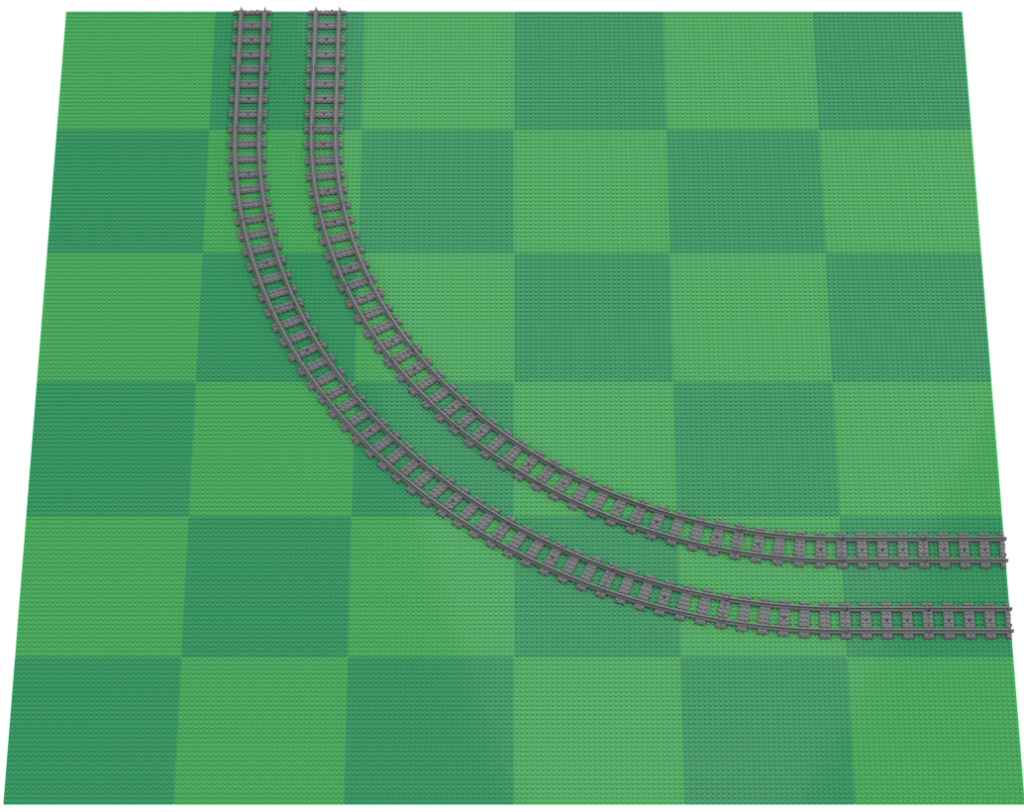
    A corner section is the equivalent of two regular sections (6 baseplates by 6 baseplates). Wide turns are required so trains can run consistently. The inside track has a turn radius of R104, and the outside track has a turn radius of R120.

    Consistency

    Tracks must remain level with standard track sections for the entire corner.

    Notes

    Because LEGO does not produce track for these wide turns, the club uses third-party track. Builders can borrow corner track from the club or get recommendations on where to order their own. The partial digital model1 shows where track pieces are placed on the section baseplates, and ballasting/baseplate instructions from L-Gauge can be used as guidance.

    Make Your Own CorNER Section

    Additional Information

    For additional questions, ask for advice in the train loop channel on Discord (members only). Often, the L-Gauge community has more comprehensive track standards. The ULUG standards aren’t a complete match, but they are a good guide if there are unique questions. A few common topics are referenced below.

    • Power: This Standard makes no provisions for electrified track. All trains are expected to provide their own on-board power.
    • Scenery: Scenery within 8 studs of track center on any Mainline shall be kept at or below rail height.
    • Tunnels: Tunnels, overpasses and other overhead obstructions shall be a minimum of 16 bricks (6 inches / 15.4 cm) above rail height.
    1. Curve track digital models from BrickTracks. ↩︎

  • LEGO Terminiology

    LEGO Terminiology

    A

    ABS

    Short for “Acrylonitrile Butadiene Styrene”. The type of plastic that LEGO bricks are made from.

    AFOL

    Short for “Adult Fan of LEGO”.  The most common term used to refer to LEGO fans who are adults. Generally pronounced “ay-foal.” See KFOL and TFOL.

    ALE

    Short for“Adult LEGO Enthusiast”. Some LEGO fans prefer to be called enthusiasts rather than fans or AFOLs, attempting to avoid the perceived stigma of the word “fanatic.”

    ALT BUILD

    Short for “Alternate Build”. A different build using only the parts from a LEGO set. See also MOD.

    Ambassador

    The title given to fan liaisons who represent fan organizations within the LEGO Ambassador Network. See LAN, RLUG, and Fan Media.

    Anti-Stud

    The indentation in the bottom of bricks and plates which serves as a stud receptacle and is one half of the mechanism by which LEGO pieces interlock. See also Stud.

    B

    Bignette

    A large LEGO creation (larger than a Vignette, but smaller than a Diorama).

    Blay or Bley

    “Bluish Gray/Grey” refers to the current LEGO gray/grey, compared to the old version “Old Gray/Grey”. Official BrickLink terms are “Light Bluish Gray” and “Dark Bluish Gray”.

    Brick

    A universal name for a LEGO piece, regardless of shape or color. More specifically, in LEGO element taxonomy, any roughly cubic LEGO piece which is 3 or more plates tall. In technical terms, used to refer a specific piece shape, regardless of color. Contrast with Element and Plate.

    Brick-Built

    A LEGO creation that is composed of basic LEGO elements, instead of more specialized elements. (For example brick built figures, animals, or objects.)

    Builder

    A LEGO fan whose primary interest is building MOCs. Contrast with Collector, though many fans are both collectors and builders.

    BURP

    Short for“Big-Ugly-Rock-Piece”. The larger of two classic pre-fabricated LEGO elements traditionally available in gray. Part number 6082. More experienced LEGO fans often encourage other builders to use brick-built landscaping rather than BURPs, but also frequently use them for internal structures. See also LURP.

    C

    Cheese Slope

    A LEGO part with a 33° slope, 1×1 stud wide and 2 plates high. It is named after the fact that yellow pieces look like a wedge of cheese.

    Clone

    Construction toys similar and often compatible with LEGO, but cheaper in quality and price, designed to compete with the LEGO brand. They are often poorly received by LEGO-fans. See also Flego.

    Collector

    A LEGO fan whose primary interest is collecting official sets. Contrast with Builder, though many fans are both collectors and builders.

    Custom

    A LEGO creation or individual element that uses non-LEGO parts or modified parts, or accessories from third-party vendors like BBG Forge, LifeLite, and BrickForge. Contrast with Purist.

    Customizer

    A LEGO-fan who is not afraid to modify LEGO parts. Customizing may include painting, cutting, drilling, melting LEGO elements, adding other non-LEGO parts to a creation, or adding details with custom-made stickers and decals. These are all considered heresy by a “purist”.

    D

    Dark Ages

    The period in a LEGO-fan’s life when he/she sets aside LEGO in favor other, non-LEGO pursuits. See also Gray Ages.

    Diorama

    A very large LEGO scene, larger than a Bignette or Vignette.

    Dirty Brickster

    A white elephant-styled gift exchange game, where each gift is LEGO-related.

    Draft

    An activity common at LEGO club meetings, in which LEGO-fans each bring a copy of a LEGO set, sort out all of the LEGO elements, and take turns picking the parts they want. An easy way to get the parts you want in larger quantities without buying multiple copies of the set yourself. See the Drafting page for more info on ULUG drafts.

    E

    Element

    A universal name for a LEGO piece, usually in a specific mold and color. Contrast with Brick.

    Element ID

    A number for a specific part mold in a specific color. Even slight changes create new element IDs for nearly identical parts.

    F

    Fan Media

    A bucket term for LEGO influencers and reviewers who are sent early copies of sets as a part of the Lego Ambassador Network. See also LAN.

    Filler

    Parts used underneath a build for structure that will never be seen, so the colors don’t matter. See also Rainbow.

    Flego

    Short for “Fake LEGO”. Construction toys similar and often compatible with LEGO, but cheaper in quality and price, designed to compete with the LEGO brand. They are often poorly received by LEGO-fans. See also Clone.

    G

    Gray Ages

    A period in a LEGO fan’s life when they step away from actively building or participating in the LEGO community, but retains interest in LEGO and does not sell their LEGO collection. See also Dark Ages.

    Greeble

    To add pseudo-technical details to a LEGO creation to enhance its appearance, frequently seen in sci-fi, space and mech creations. Detailing is called “greebles” or “greebling”.

    H

    Habitat

    A stackable build pattern built on an 8×8 plate. The plate is set at a 45-degree angle and the two back edges serve as walls or a background. Habitats combine and stack, making them ideal for small, easy collaborations.

    Half-Stud Offset

    A building technique that allows building without regard to the standard alignment of studs on a plate, usually achieved with a jumper plate.

    I

    Illegal

    LEGO building techniques that break the “rules” for connections between LEGO elements used by official LEGO set designers – particularly connections that stress the LEGO elements.

    Inventory

    The list of LEGO elements included in an official LEGO set. Several LEGO fan sites host set inventories, including PeeronBrickLink, or BrickSet.

    J

    Jumper Plate

    A 1×2-stud LEGO plate with only 1 stud in the center. Useful for half-stud offset building.

    K

    KFOL

    Short for “Kid-Fan-of-LEGO”. The LEGO Group’s primary target demographic aged 5-12. See also AFOL and TFOL.

    Knolling

    The process of arranging a series of elements next to each other in an aesthetically pleasing manner, without the pieces being connected. The parts are often arranged in rows by color, size, shape, or all three. Knolling is often done as a sorting method prior to building a set, or as a way of displaying the inventory of a set or model.

    Kragle

    Glue used to permanently attach LEGO parts together (typically discouraged). The name comes from a plot element from The Lego Movie.

    L

    LAN

    Short for the “LEGO Ambassador Network”. The LEGO Company’s official outreach program for adult fans. LEGO recognizes fan media and local groups and grants an ambassadorship with access to the LAN. See also Ambassador, Fan Media, and RLUG.

    LBR

    Short for “LEGO Brand Retail”. A brick and mortar LEGO store.

    LEGO building techniques that follow building guidelines for official LEGO set designers.

    Legos

    Don’t say that! Technically, LEGO is an adjective to describe bricks or elements and doesn’t have a plural. In conversation, AFOLs use “LEGO” as both a singular and plural noun, like one might with moose or sheep.

    LGMS

    Short for “L-Gauge Modular System”, which is a set of standards for interconnecting LEGO train layouts. See LGMS.org for more details.

    LUG

    Short for “LEGO-Users-Group”. Local or regional LEGO clubs that regularly meet in-person for collaborations and events. Many LUGs are sponsored by LEGO as a part of the Lego Ambassador Network. See also LAN.

    LURP

    Short for “Little-Ugly-Rock-Piece”. The smaller of two classic pre-fabricated LEGO elements traditionally available in gray and frequently included in LEGO castle sets. Part number 6083. More experienced LEGO fans often encourage other builders to use brick-built landscaping rather than LURPs. See also BURP.

    M

    Microfig

    Small figures (half the size of regular minifigs) from the LEGO Games series.

    Microscale

    Refers to builds that are smaller than minifig scale.

    Midi-Scale

    Refers to builds that are between miniature and minifig scale. They do not include minifigures, but are much more detailed than mini sets.

    MILS

    Short for “Modular Integrated Landscaping System”. Landscaping system to use in collaborative displays with LEGO elements. See the MILS website for more details.

    Mini-doll

    The thin, curved figures featured in LEGO Disney Princess, Elves, and Friends themes. First introduced in 2012, the design is a trademark of The LEGO Company.

    Minifig

    Short for Minifigure. The blocky miniature figures featured in most LEGO sets. First introduced in 1978, the design is a trademark of The LEGO Company.

    Minifig Scale

    A LEGO creation built for the scale of standard LEGO minifigures.

    Miniland Scale

    A style and scale of building in which figures are approximately 10 bricks tall and most studs are left exposed. The name derives from the popular “Miniland” attractions at LEGOLAND theme parks which employ this style.

    MOC

    Short for“My-Own-Creation”. A LEGO creation designed and built by a LEGO-fan without instructions. Pronounced as “mock.” Learn more on the ULUG MOCs page.

    MOD

    Short for “Modification”. A LEGO creation that is made by customizing an official set or another builder’s creation. See also Alt Build.

    Modular

    Refers to either the technique of building in combinable units, or to the specific line of “modular” building sets released by LEGO (for example, the Cafe Corner).

    MSRP

    Short for “Manufacturer’s Suggested Retail Price”. The official price for a LEGO set as established by the LEGO Group for a particular market. Individual retailers may set their own prices higher or lower than MSRP, and MSRP may vary from country to country.

    N

    NLSO

    Short for “Non-LEGO Significant Other”. Refers to partners or spouses of AFOLs who don’t play with LEGO.

    NPU

    Short for “Nice Parts Usage”. It refers to when builders use a LEGO element in a creative or unique way. Classic examples include the various uses of frogs in sets like the bonsai tree set or the crossaint as architectural detailing in the Parisian Restaurant modular building set.

    P

    PAB

    Short for“Pick-A-Brick”. Buy individual bricks in the quantities you want form LEGO’s online store or LEGO brand retail stores. See also PAB Wall.

    PAB Wall

    The Pick-A-Brick wall at LEGO brand retail stores. See also PAB.

    Parts Pack

    A set purchased only for the parts inside, not to build as instructed.

    Plate

    Any LEGO piece which is 1/3 the height of a Brick. See also: Brick.

    Polybag

    A small LEGO set sold in sealed plastic bags, instead of in a box.

    Purist

    A LEGO-fan who only uses official LEGO elements, or a LEGO creation that only contains official LEGO elements with no custom parts. Contrast with Custom.

    R

    Rainbow

    Parts used underneath a build for structure that will never be seen, so the colors don’t matter. See also Filler.

    RLUG

    Short for “Recognized LEGO Users Group”. These LUGs are members of the LEGO Ambassador Network. See also Ambassador, LUG, and LAN.

    S

    S@H / SAH

    Short for “Shop at Home”, it refers to the LEGO online store at www.lego.com.

    SHIP

    Short for“Seriously Huge Investment in Parts”. Sometimes Super or Significantly Huge Investment in Parts. A very large LEGO creation — particularly a LEGO space creation. As used in the LEGO space fan community, a SHIP is generally at least 100 studs long.

    Sigfig

    Short for “signature minifig”. The minifig version of a LEGO-fan used as an online avatar or representation of themself.

    SNOT

    Short for “Studs-Not-On-Top”. A building technique that places LEGO elements on their sides or even upside down to achieve the shape or structure the builder wants in their creation.

    Sprue

    Small plastic connector between elements when molded. When removed, a “sprue mark” is often left behind. Many builders try to hide as many sprue marks as possible while building.

    STAMP

    Short for Stickers-Across-Multiple-Pieces”. Rarely seen in sets, this practice is typically discouraged as it makes reusing the parts difficult.

    Stud

    The distinct cylindrical bump or knob on the surface of LEGO bricks which fits inside an anti-stud and serves as one half of the mechanism by which pieces interlock. Studs are frequently used as a unit of measurement: e.g. a model is 40 studs long. See also Anti-Stud.

    Studless

    A building style in which visible studs are minimized or, ideally, eliminated. Usually accomplished by a combination of tiles and SNOT techniques.

    Swooshable

    A quality that allows a LEGO creation to be picked up and flown around a room as the builder makes flying and/or shooting noises.

    T

    Tablescrap

    A small, clever build that doesn’t stand alone as a completed creation. From “table scraps,” i.e. leftovers. A tablescrap may be a simple exploration of a technique (such as an interesting way to combine several elements to make an odd shape), or may be a recognizable item that’s just too small to merit presentation on its own (such as a minifigure chair). Many builders set aside their tablescraps and save them for use in future creations.

    TFOL

    Short for“Teen-Fan-of-LEGO”. See also AFOL and KFOL.

    Tile

     Any LEGO plate which is devoid of all or most studs, giving it a smooth upper surface.

    TLG

    Short for“The LEGO Group”. The privately held parent company for all LEGO-related brands and companies worldwide

    Token

    A small built, printed part, or sticker left by a build at a convention as a way to show appreciation for the build.

    Travis Brick

    A modified 1×1 brick with studs on 4 sides. Named for Travis Kunce, a deceased fan who was known for his enthusiasm for the piece. Part number 4733. A common piece used in SNOT building.

    U

    UCS

    Short for“Ultimate Collector’s Series”. A series of large LEGO Star Wars sets designed for older teens and adults. They are larger than minifig scale.

    V

    Vignette

    A small scene recreated on a small plate. See also Bignette and Diorama.

    W

    WIP

    Short for “Work-In-Progress”. A MOC that is not finished.

    #

    6-wide

    Refers to the width of train locomotives and rolling stock as 6 studs wide in packaged sets that LEGO produces. Some builders stay in this scale to build their MOC trains. This terminology is also becoming popular with other vehicles, like Speed Champion cars.

    8-Wide

    Refers to the width of train locomotives and rolling stock as 8 studs wide which roughly translates to 1:48 scale. This is the most popular LEGO train scale among enthusiasts. This terminology is also becoming popular with other vehicles, like Speed Champion cars.

    10-wide

    Refers to the width of train locomotives and rolling stock as 10 studs wide which roughly translates to 1:38 scale and matches scale with the width between standard LEGO train track elements. Builders in this scale are often referred to as 10-Wide Master Race because of their elitist attitudes towards other scales. Nicknamed “The One True Scale”, 1:38, or the least popular LGP (L-Gauge Proto).